Dryers in Hanahan that run cold, slow or loud, with the duct given a manometer reading before the heater is given the blame. 18–22 min from Long Point Road on the 526 west batch.
Hanahan dryers sit in garages and slab utility rooms in the older neighborhoods and in upstairs laundries with attic runs in Tanner Plantation, and the once-over on the 526 west batch begins with the two things those rooms add: a duct no one has brushed, and a power connection that has been rusting through ten humid months.
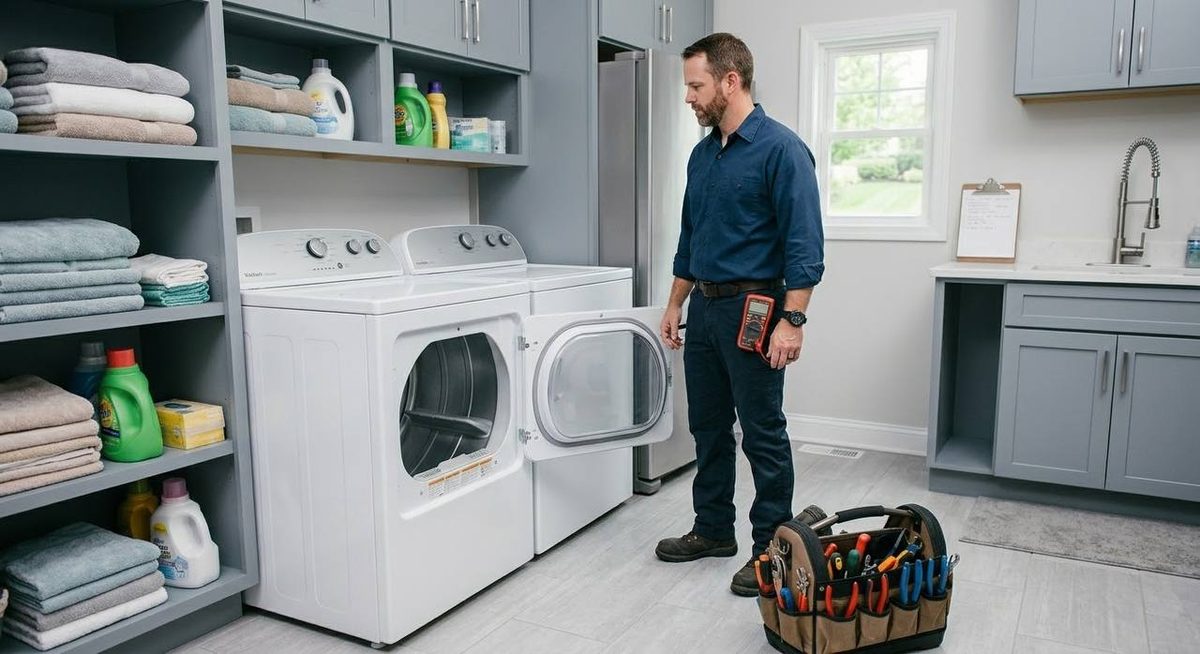
Wes reads the exhaust with a manometer, finds the hood — a side wall behind a shrub in Otranto, a roof in Tanner — and looks at the terminal block and the cord before the element is metered, since weak heat from a garage dryer is a green connection as often as a worn heater, and a green plug is a fire risk before it is a finding.
Dryer Repair on the 526 west batch — Hanahan
Worth mentioning on the phone
Runs the full cycle, clothes still damp
Hot at first, then lukewarm, then hot again
A squeal or a thump that tracks the drum
Another blown fuse, same summer
Our whole Tanner Plantation street is replacing the same part. One builder phase, one install year, one wear curve. By the time yours goes, the part is usually already riding on the van.
From the ledger
The Garage Run Nobody Brushed and the Attic Run in Tanner
The sixties and seventies ranches push their garage dryers’ exhaust a few feet sideways to a wall hood, which sounds simple — until four decades of lint, a damp-rusted flap and a foil elbow flattened against the drywall behind the machine make a short run behave like a plugged one. Wes cleans both ends, swaps the foil for rigid pipe, measures again, and on a run that short the slip is usually labor and a flap rather than a heater the duct would have cooked again by spring.
Tanner Plantation stacked its laundries on the second floor and sent the exhaust up into the attic and out a roof cap — forty feet of pipe that sags, collects lint at the low point and ends in a flap the damp rusts shut — and the builder-package dryers across a street wear their idler pulleys and rollers on the same schedule, so the set for one Foster Creek address tends to fit the next three. The exhaust reading says what the attic run costs, the drum hardware goes in as a set, and the ledger says when a sagging section needs a duct crew.
Worth knowing on this run. Gas reaches parts of Tanner Plantation and the newer Hanahan streets, and a gas dryer gets its igniter, its coils and its flame sensor metered one after the other, with the appliance valve as the boundary. Drum noise on any Hanahan dryer means rollers, idler pulley, glides and belt get replaced together, since a household two rivers away should not have to book a return trip over whichever part squeals next.
Three from the phone
Dryer Repair in Hanahan: Asked and Settled
Our Otranto garage dryer barely heats and the plug is green.
You already found it. The plug and receptacle get replaced for safety, then the once-over — with the power path fixed the element usually tests fine.
Our Tanner Plantation dryer needs two cycles a load.
The attic run to the roof hood, nearly always. The exhaust reading says what it costs, and the slip often turns out to be a duct note with nothing to buy.
How is Hanahan scheduled from Mount Pleasant?
As a 526 west batch — Tanner and Foster Creek together, Otranto and Eagle Landing together — timed away from the Rivers Avenue crawl. No-heat dryers ride first in the batch.
Coil, fan, compressor — then the insideRollers, idler, glides and belt go in togetherOld hoses replaced while the panel is offEvery burner lit and its flame readCloudy glass sorted into dosing or minerals