How the Once-Over Runs
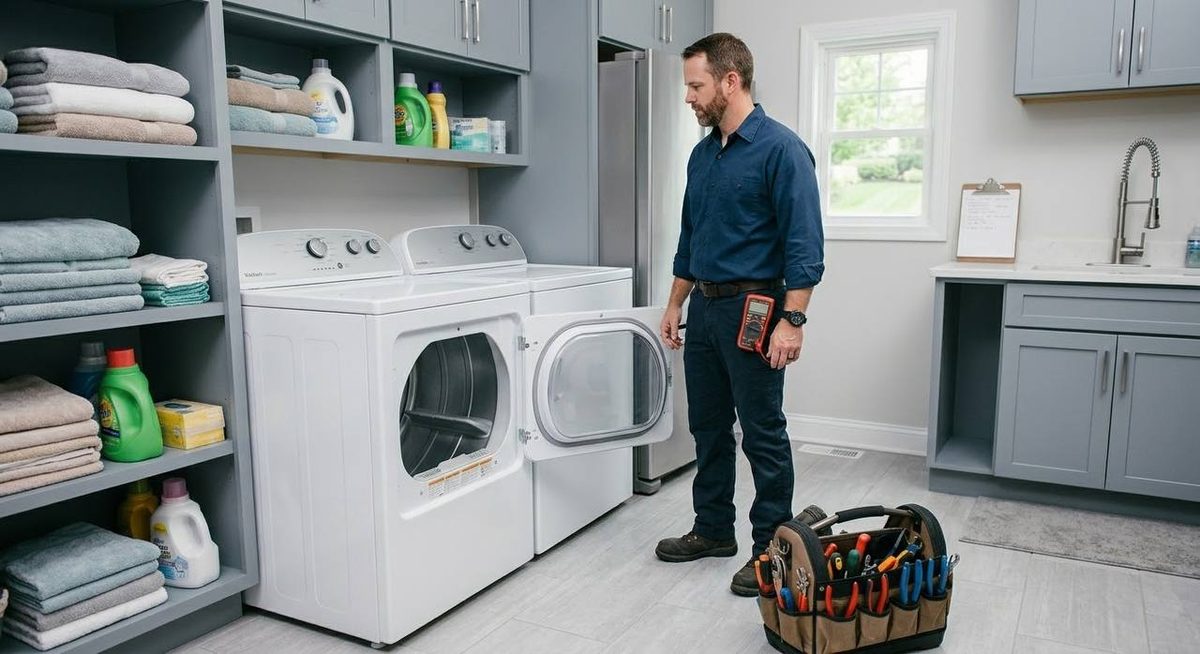
The once-over follows the air. Wes opens the lint filter housing and the blower, looks at what has packed in there, then puts a manometer on the exhaust to see what the duct is costing, then walks the run to wherever the hood is — a roof in Park West, a wall two units over in a Belle Hall townhome, a lattice enclosure under a beach house on the Isle of Palms. If the air is moving properly, the element or burner, the thermostats and the fuse each get metered and only the one that fails goes on the slip.
Roof Hoods, Shared Chases, and the Enclosure Under the House
Park West, Carolina Park, Dunes West and the Daniel Island builder homes build the laundry on the second floor and send the exhaust up into the attic and out a roof cap — forty feet of pipe that sags, banks lint at the low point and ends in a flap the damp rusts shut. Belle Hall, I’On and the Long Point townhomes share a chase along a row, and one stuck damper slows every dryer on it. The beach houses on the islands run the duct down through the enclosure at grade and out near the sand, where salt freezes the hood shut. In all three the air reading tells the story before the front panel does, and the slip says plainly when it is the duct and not the dryer.
Humidity is the East Cooper wrinkle inside the machine. A dryer in an unconditioned laundry room or an under-house enclosure greens its terminal block, its door switch and the connectors on its element, and feeble heat on one is a green connection as often as a worn heater. Wes reads the power path before naming a heating part, and swaps a green plug for safety before anything else.
Noise from the drum means the rollers, the idler pulley, the glides and the belt get replaced together — they wear together, and swapping just the loud one means coming back for the next. Natural gas runs along the Highway 17 corridor and into the newer subdivisions, so a gas dryer gets its igniter, coils and flame sensor metered in turn, stopping at the appliance valve; heat-pump and condenser dryers in the condos get a once-over of their own, filters and coil and pump.
- Runs the full cycle, clothes still damp
- Hot at first, then lukewarm, then hot again
- A squeal or a thump that tracks the drum
- Another blown fuse, same summer
- A hot smell on the high setting
- Gas model glows, ticks, never lights