Dryers in Sullivan's Island that run cold, slow or loud, with the duct given a manometer reading before the heater is given the blame. 15–20 min from Long Point Road on the island run.
Sullivan’s Island dryers sit in cottage laundry rooms improvised onto porches in the 60s and in the second-floor laundries of the new houses built beside them, and both exhaust into salt air past a hood flap that seizes within a couple of seasons. The once-over starts at that flap and works back toward the machine.
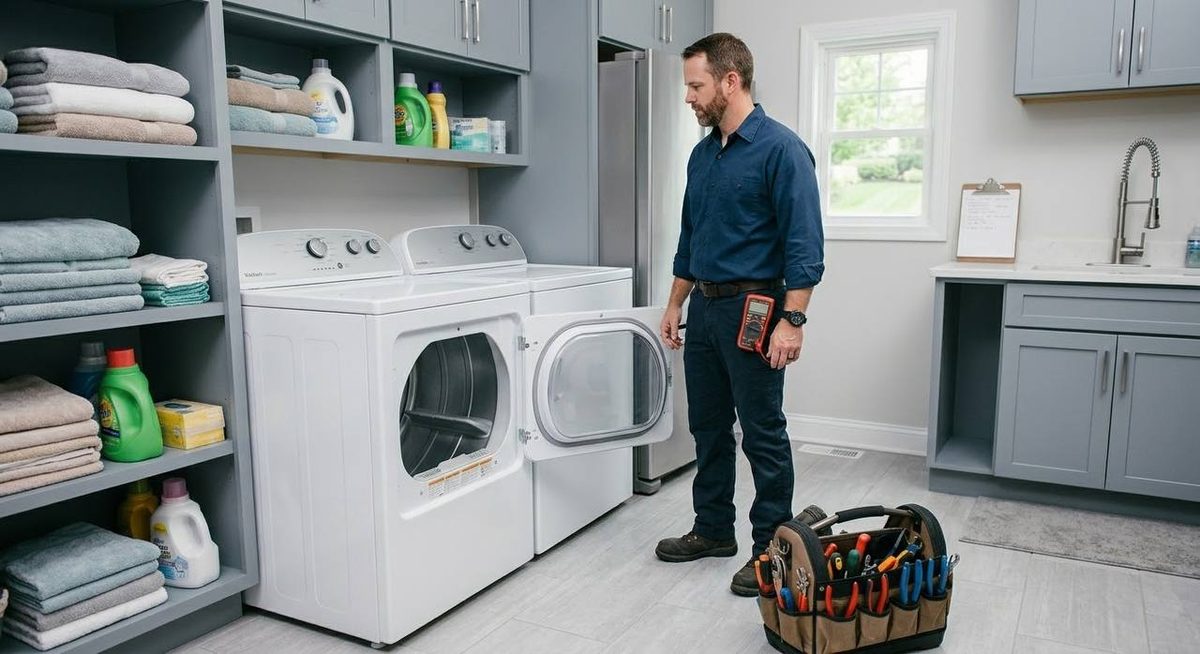
Wes reads the exhaust with a manometer, finds the hood — under a porch, at sand level beneath a raised house, on a roof — and clears and frees it before the element, thermostats or fuse are metered. The island is one stop on the run, Station 18 to Station 32 in a single pass, timed around the swing bridge.
Dryer Repair on the island run — Sullivan's Island
Worth mentioning on the phone
A hot smell on the high setting
Gas model glows, ticks, never lights
Runs the full cycle, clothes still damp
Hot at first, then lukewarm, then hot again
We live out of state — can this work by phone? That is most of the island. A lockbox visit arranged by phone, a slip you approve by text, and a ledger written for reading at a distance.
From the ledger
Porch Laundries and Long New Ducts
A cottage laundry added to a porch got its dryer vent through whatever wall was handy, in foil, with two elbows more than the run needed, and sixty years of lint have found the low points. The manometer puts a number on what that costs; Wes clears what a brush reaches from both ends, swaps foil for rigid duct wherever he can reach it, and notes in the ledger when a buried section is a duct crew’s job rather than another element. On a cottage circuit he also reads the outlet under load, because a leg that sags gives weak heat that reads exactly like a dying element.
The new houses are the opposite problem: a laundry a story or two above grade with a long duct down through the house and out beneath it, where the hood flap sits in ocean air and seizes. A two-year-old dryer that needs two cycles per load on Sullivan’s is that flap or that run nine times for every failed part. The exhaust reading says which, and the slip says so plainly.
Worth knowing on this run. Salt reaches the wiring as well as the duct: a terminal block, a door switch or an element connector greened by ocean air gives weak heat that reads like a worn element. The power path gets inspected before a heating part is priced, and a green plug is swapped for safety before anything else. Drum noise means rollers, idler pulley, glides and belt are replaced as one set.
Three from the phone
Dryer Repair in Sullivan's Island: Asked and Settled
Cottage dryer on Station 22 takes two cycles.
A sixty-year-old porch vent in foil, most likely. The exhaust is measured and the run cleared as far as a brush reaches; the slip often carries no parts.
New house, new dryer, still slow.
The long duct down through the house and the flap at sand level. The reading at the exhaust says what it costs, and the ledger says whether a duct crew is needed.
Dryer heats weakly in a raised-house enclosure.
The terminal block and cord are inspected first — ocean air greens connections before parts wear. A green plug gets swapped for safety, then the dryer gets its once-over.
Blower, manometer, hood — then the partsCloudy glass sorted into dosing or mineralsA sealed-system verdict written honestlyAgitator out, coupler and gearcase in reachIgniter, spark module, valve — in that order